Renew the colour on a suitable surface
Render Respray Sandbach | Colour Changes and Preparation
A different colour can change the appearance of a house without replacing its entire render system. That option depends on the existing finish being suitable for the proposed coating. In Sandbach, a respray quotation should explain the cleaning, repairs and compatibility checks as clearly as the colour choice. Spraying is a method of application; it does not make an unsuitable product or defective background acceptable.

On this page
Separate a colour problem from a failed surface
A faded but secure finish is different from one with loose patches, recurring cracks or an active leak. Establish which condition you have before comparing decorative options. A new coating can make a surface look more consistent, but it does not restore adhesion between failed render and the wall.
Staining also needs interpretation. Deposits below a gutter, surface growth in a shaded area and an old paint film turning powdery may require different preparation. The quotation should identify what will be cleaned or removed and what needs repair. If those items are left vague, a fresh colour can conceal the uncertainty only temporarily. The repairs guide explains how to define the underlying work.
- Clean Washed down, with algae and mould treated and left to work.
- Repair first Cracks and hollow patches are repaired before any coating.
- Prime or stabilise Where the coating maker requires it on that surface.
- Coating Usually two coats of a breathable masonry or silicone coating.
The usual order of work. The survey and the chosen products decide the actual steps.
Identify the existing finish and coatings
Retain any original product information, previous invoices or colour references that are available. They can help establish the surface the new coating must suit. If the history is unknown, the assessment may need appropriate investigation or tests. Appearance alone is not a reliable way to identify every render or paint type.
A silicone finish or monocouche surface should be considered with the relevant manufacturer's guidance. Traditional lime work needs particular care over compatible decoration and moisture behaviour. A coating marketed for masonry should not be assumed suitable for every one of these backgrounds.
If several old coatings or repairs are present, describe those variations. A uniform final colour does not mean the preparation can be identical everywhere. The specification should state how weak, powdery or incompatible material will be dealt with before the finish is applied.
| Stage | Detail to agree |
|---|---|
| Assessment | Existing render, coatings and defects |
| Cleaning | Method appropriate to the surface and deposits |
| Repair | Areas, materials and readiness before coating |
| Coating | Named product and compatibility guidance |
| Application | Masking, access, weather and coat sequence |
| Review | Approved colour, coverage and reinstatement |
Choose the colour on the building
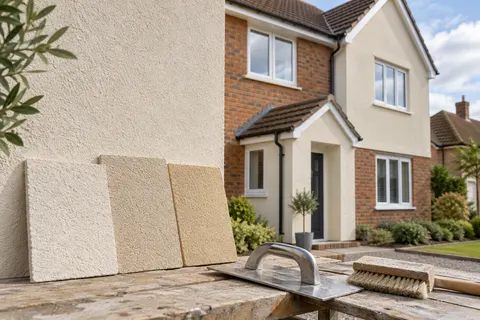
A sample is most useful beside the features that will stay unchanged. Brickwork, roof tiles, windows and paving can alter how a colour is perceived. A narrow recess may look darker than the same finish on an open face, and a rough texture creates its own shadows. View the sample in more than one light before making the final decision.
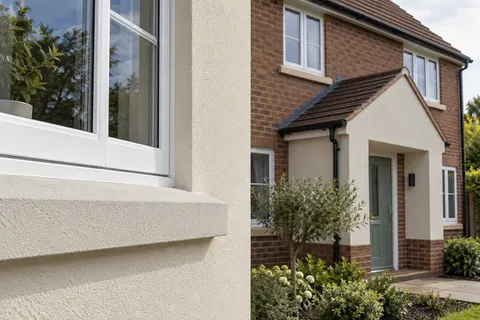
On a porch or bay, decide whether the small faces will match the main elevation or provide a deliberate contrast. Keep the stopping lines clear. A colour change that ends awkwardly beside a return can look incomplete even when the coating itself is well applied. If only one elevation is changing, the wall guide helps consider its boundary with the retained exterior.
Do not confuse new colour with new texture
A coating follows the shape of the existing surface. It can alter colour and may change the visual emphasis of a texture, but it does not turn coarse pebbledash into a flat rendered wall. If the texture itself is the problem, compare the proposed result with pebbledash removal and a suitable replacement finish.
Similarly, a sound but uneven patch may remain visible after decoration because light still catches its profile differently. The preparation should identify whether the patch can be improved and what appearance is realistic. Agree this before the whole elevation is coated, rather than assuming additional paint will remove every surface difference.
Plan masking and access carefully
Windows, doors, roof coverings, fittings and adjacent surfaces need appropriate protection for the application method. Spraying makes the control of overspray and working conditions especially relevant. The proposal should explain how the work area is managed, including nearby vehicles, neighbouring property and surfaces that cannot be removed.
Access must allow safe preparation as well as application. A quick spray pass is only one part of the job; cleaning, repairs and detailed edges still need to be reached properly. If the property remains occupied, agree which doors and routes stay available and how people will be kept out of the work zone. HSE guidance provides the general framework for that planning.
Use the product instructions to set the sequence
The surface must be ready for each stage under the coating manufacturer's requirements. Cleaning, repair and drying cannot be compressed into an arbitrary timetable simply because a colour change sounds less substantial than replacement render. Temperature, weather and substrate condition all affect whether application should proceed.
Ask how interrupted work will be handled on a continuous face and how the specified coat sequence will be maintained. The exact method depends on the product and elevation. A clear proposal names the materials and the relevant conditions, rather than promising that every house can be completed in the same short period.
Keep the colour reference and care advice
At completion, compare the finish with the agreed sample and scope. Check edges, masked surfaces and reinstated fittings as well as the main wall. Record unfinished work separately from defects so the remaining actions are clear. Keep the product, colour and application date for future maintenance.
Cleaning and later recoating should remain compatible with that system. If new cracking or staining appears, investigate its cause rather than immediately adding another decorative layer. For a larger change involving several surfaces and repairs, house rendering provides a wider project framework, while the Sandbach homepage links all of the service options.
Common questions
Will spraying make an old rough finish smooth?
No. A coating generally follows the existing texture. If a flatter surface is wanted, the background and a suitable replacement or levelling system need assessment as a different scope.
Can the new colour be guaranteed to match a screen image?
A screen image is only a guide. Use a sample of the proposed coating on the relevant background and view it beside retained materials before agreeing the colour.
See housing and planning information for Sandbach and nearby places, including the source and geography behind each figure.